
Exploring the science and technology behind interstellar travel in the Cybertech universe.
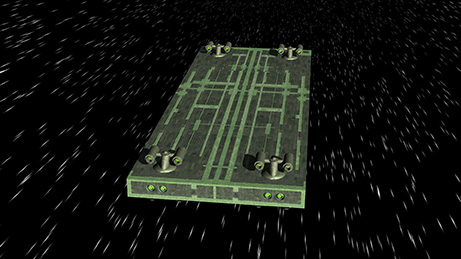
Faster-than-light travel has long been one of the defining technologies of science fiction. Without it, journeys between neighboring stars would take years or decades, while traveling across an entire galaxy could require thousands of years.
In the Cybertech universe, faster-than-light (FTL) technology has made interstellar exploration, trade, colonization, and warfare possible. Civilizations spanning hundreds or even thousands of star systems rely on advanced propulsion systems to overcome the enormous distances separating the stars.
However, not all faster-than-light technologies operate in the same way.
The Terran Alliance employs three primary methods of FTL travel: Warp Bubble Drives, Space Fold Drives, and Wormhole Drives.
Each technology approaches the challenge of interstellar travel differently, offering distinct advantages and limitations.
Also, Check out the specific FTL speed chart for more details Here
The Challenge of Interstellar Travel
To understand the importance of faster-than-light technology, consider the distances involved in traveling between stars.
Light travels through a vacuum at approximately 299,792 kilometers per second. At this speed, a beam of light could circle Earth more than seven times in a single second.
Yet even at this extraordinary velocity, traveling between stars takes considerable time.
Alpha Centauri, the nearest stellar system to our Sun, is approximately 4.37 light-years away. A spacecraft traveling at the speed of light would require more than four years to reach it, as measured in Earth’s reference frame.
Crossing the Milky Way, which spans roughly 100,000 light-years, would take approximately 100,000 years.
For a civilization attempting to maintain contact between distant colonies, such travel times would make a unified interstellar society extremely difficult.
Cybertech addresses this problem through technologies that manipulate spacetime rather than relying exclusively on conventional propulsion.
1. Warp Bubble Drives — Continuous Faster-Than-Light Travel
The Warp Bubble Drive is one of the most versatile forms of faster-than-light propulsion employed by the Terran Alliance.
Unlike conventional engines, which accelerate a spacecraft through space, a Warp Bubble Drive creates a localized distortion of spacetime surrounding the vessel.
Within this distortion, the spacecraft occupies a region of relatively stable spacetime while the surrounding geometry is manipulated to produce effective faster-than-light movement.
The underlying principle resembles the theoretical Alcubierre warp-drive concept, although the practical technologies depicted in Cybertech are fictional.
How Warp Bubble Travel Works
A Warp Bubble Drive generates and maintains a controlled spacetime field around the spacecraft.
The vessel travels within this field, allowing it to cross interstellar distances at effective velocities exceeding the speed of light.
Unlike instantaneous transportation systems, warp travel is continuous.
A spacecraft must still traverse the distance between its departure point and destination, but it does so at an extraordinary rate.
Terran Alliance warp technologies operate across a broad range of effective velocities, with drive capabilities extending from approximately the speed of light to tens of thousands of times that speed.
Advanced systems can reach effective velocities approaching 50,000 times the speed of light (50,000c).
Advantages of Warp Bubble Drives
Warp Bubble Drives offer several important advantages.
Continuous navigation: A vessel travels along a route rather than making a single instantaneous transition.
Flexible travel distances: Warp technology can be used for journeys of varying lengths without requiring a fixed jump distance.
Operational versatility: Warp propulsion is suitable for exploration, patrol operations, and travel between relatively nearby star systems.
However, maintaining a warp bubble requires a continuous supply of energy.
The faster a vessel travels, the more demanding its propulsion requirements can become.
As a result, the maximum speed of a spacecraft depends on the capabilities of its installed warp drive and available power systems.
2. Space Fold Drives — Bringing Distant Locations Together
Space Fold Drives represent a fundamentally different approach to faster-than-light travel.
Rather than continuously traveling through the space separating two locations, a Space Fold Drive manipulates spacetime to create a temporary connection between distant regions.
The concept can be illustrated using a sheet of paper.
Imagine drawing two points on opposite ends of the sheet.
Normally, traveling between these points requires crossing the distance separating them.
But if the paper is folded so the two points touch, the distance between them becomes dramatically shorter.
A Space Fold Drive applies a fictional technological interpretation of this principle to three-dimensional space.
How Space Fold Travel Works
Before initiating a jump, the spacecraft’s drive system must accumulate sufficient energy to generate the required spacetime distortion.
Once the necessary energy has been stored, the drive activates and creates a temporary connection between the departure point and destination.
The spacecraft then transitions between the two locations without having to travel conventionally across the intervening distance.
Unlike Warp Bubble Drives, Space Fold Drives do not require continuous propulsion throughout the journey.
Instead, their primary energy expenditure occurs during activation.
The Importance of Energy Storage
One of the defining characteristics of Space Fold technology is its dependence on stored energy.
The distance a spacecraft can travel is limited by the capabilities of its drive system and the energy available for activation.
Longer jumps can require greater energy reserves, while shorter jumps may be possible with less stored energy.
This makes energy storage and recharge time important considerations for spacecraft designers.
A vessel capable of making extremely long jumps may still require substantial preparation before activating its drive.
Strategic Advantages
Space Fold Drives are particularly valuable for long-distance transportation.
They allow spacecraft to bypass enormous stretches of interstellar space, making them useful for rapid fleet deployments, exploration missions, and travel between distant regions of the galaxy.
However, their dependence on stored energy means that consecutive jumps may be limited by recharge requirements.
This creates an important distinction between Space Fold and Warp Bubble propulsion.
Warp technology provides continuous movement, while Space Fold technology allows a vessel to relocate across great distances through individual jumps.
3. Wormhole Drives — Creating Shortcuts Through Spacetime
The third major faster-than-light technology employed by the Terran Alliance is the Wormhole Drive.
Like Space Fold technology, wormhole propulsion manipulates spacetime to connect distant locations.
However, the two technologies accomplish this through different mechanisms.
A Wormhole Drive generates a temporary passage through spacetime, allowing a spacecraft to travel between locations that would otherwise be separated by enormous distances.
The theoretical concept of wormholes originates from general relativity, although the creation of traversable wormholes remains speculative in real-world physics.
In Cybertech, advanced civilizations have developed the technology necessary to generate and stabilize these passages.
How Wormhole Travel Works
A Wormhole Drive uses an enormous concentration of energy to create a controlled spacetime tunnel.
Once the passage has formed and stabilized, the spacecraft can traverse it to reach its destination.
From the perspective of an outside observer, the vessel can appear to have crossed an extraordinary distance in a very short period.
The spacecraft itself does not necessarily exceed the local speed of light while traveling through the passage.
Instead, the wormhole provides a shortcut through the geometry of spacetime.
Advantages of Wormhole Drives
Wormhole propulsion offers the potential for extremely rapid transportation across vast distances.
This makes it particularly valuable for civilizations operating across large regions of space.
However, generating and stabilizing a traversable wormhole requires advanced technology and substantial energy.
The drive must establish a stable connection long enough for the spacecraft to complete its passage.
These requirements distinguish wormhole propulsion from the continuous operation of Warp Bubble Drives and the discrete transitions of Space Fold Drives.
Why Does the Terran Alliance Use Three FTL Technologies?
One of the distinguishing characteristics of Terran Alliance spacecraft is their ability to employ multiple faster-than-light propulsion systems.
Rather than relying exclusively on a single technology, many vessels are equipped with combinations of Warp Bubble, Space Fold, and Wormhole Drives.
This provides considerable operational flexibility.
Each drive serves a different purpose.
| Technology | Travel method | Primary advantage |
|---|---|---|
| Warp Bubble Drive | Continuous spacetime distortion | Flexible, sustained FTL travel |
| Space Fold Drive | Temporary connection between distant locations | Long-distance jumps |
| Wormhole Drive | Traversable spacetime passage | Extremely rapid travel across vast distances |
Although multiple FTL systems can be installed aboard the same spacecraft, only one can actively propel the vessel at a time.
However, inactive systems can prepare for subsequent operations, including accumulating energy for future jumps.
This allows spacecraft to plan complex journeys using different propulsion methods.
For example, a Terran Alliance battlecruiser might use a Space Fold Drive to cross a substantial portion of the galaxy before switching to Warp Bubble propulsion for the final approach to its destination.
The ability to combine different travel methods gives Terran spacecraft greater flexibility when responding to emergencies, conducting exploration missions, or deploying military forces.
The Role of Exotic Matter
Manipulating spacetime on the scale required for faster-than-light travel presents extraordinary technological challenges.
In theoretical physics, certain proposed spacetime geometries involve unusual distributions of energy, including negative energy densities.
In Cybertech, advanced exotic-matter generation systems play an important role in supporting faster-than-light propulsion.
These systems produce the specialized conditions and gravitational effects necessary for spacecraft to manipulate spacetime.
The capabilities of a vessel’s exotic-matter generation equipment can therefore influence the performance of its FTL systems.
As with conventional propulsion, spacecraft designers must balance power generation, equipment size, energy storage, and operational requirements.
This is particularly important for military vessels, which must allocate their available resources between propulsion, weapons, shields, and other essential systems.
Faster-Than-Light Travel and Interstellar Warfare
FTL propulsion has fundamentally transformed military strategy in the Cybertech universe.
A civilization capable of moving warships between star systems in a matter of hours or days can respond to threats across enormous distances.
However, the differences between FTL technologies also create tactical considerations.
A vessel relying on continuous warp propulsion may have different operational limitations from one preparing to initiate a Space Fold jump.
Energy reserves, drive readiness, and the condition of a spacecraft’s propulsion systems can influence its ability to escape danger or respond to an emerging threat.
This becomes especially important when a spacecraft suffers damage to its faster-than-light systems.
Without functioning FTL propulsion, even the most powerful warship can become isolated in an unfamiliar star system.
For the Terran Alliance, maintaining reliable faster-than-light capability is therefore essential to both exploration and military operations.
The Future of Faster-Than-Light Technology
As civilizations in the Cybertech universe continue to advance, their understanding of spacetime manipulation evolves.
Improvements in energy generation, exotic-matter technology, and propulsion efficiency allow newer generations of spacecraft to travel farther and faster.
These advances also influence the balance of power between interstellar civilizations.
A technological breakthrough that dramatically reduces jump preparation time or increases maximum travel distance could transform exploration, trade, and warfare.
In a galaxy where civilizations are separated by thousands of light-years, the ability to cross those distances efficiently can be just as important as the strength of a fleet’s weapons.
Conclusion
Faster-than-light travel is one of the technologies that makes the Cybertech universe possible.
Through the development of Warp Bubble, Space Fold, and Wormhole Drives, civilizations have overcome the practical limitations imposed by interstellar distances.
Each technology offers a different approach to manipulating spacetime, and each provides advantages suited to particular missions.
For the Terran Alliance, combining these systems allows spacecraft to operate across enormous distances while maintaining the flexibility required for exploration, defense, and interstellar diplomacy.
Although these technologies remain fictional, they draw inspiration from genuine scientific questions about the nature of space, time, gravity, and the structure of the universe.
And in Cybertech, those questions have become the foundation of an interstellar civilization.
Explore the Cybertech Universe
Discover the starships, civilizations, and technologies of Cybertech through our free science-fiction comics.
Cybertech is an original science-fiction universe exploring interstellar civilizations, advanced technology, and the conflicts that shape the future of the galaxy.